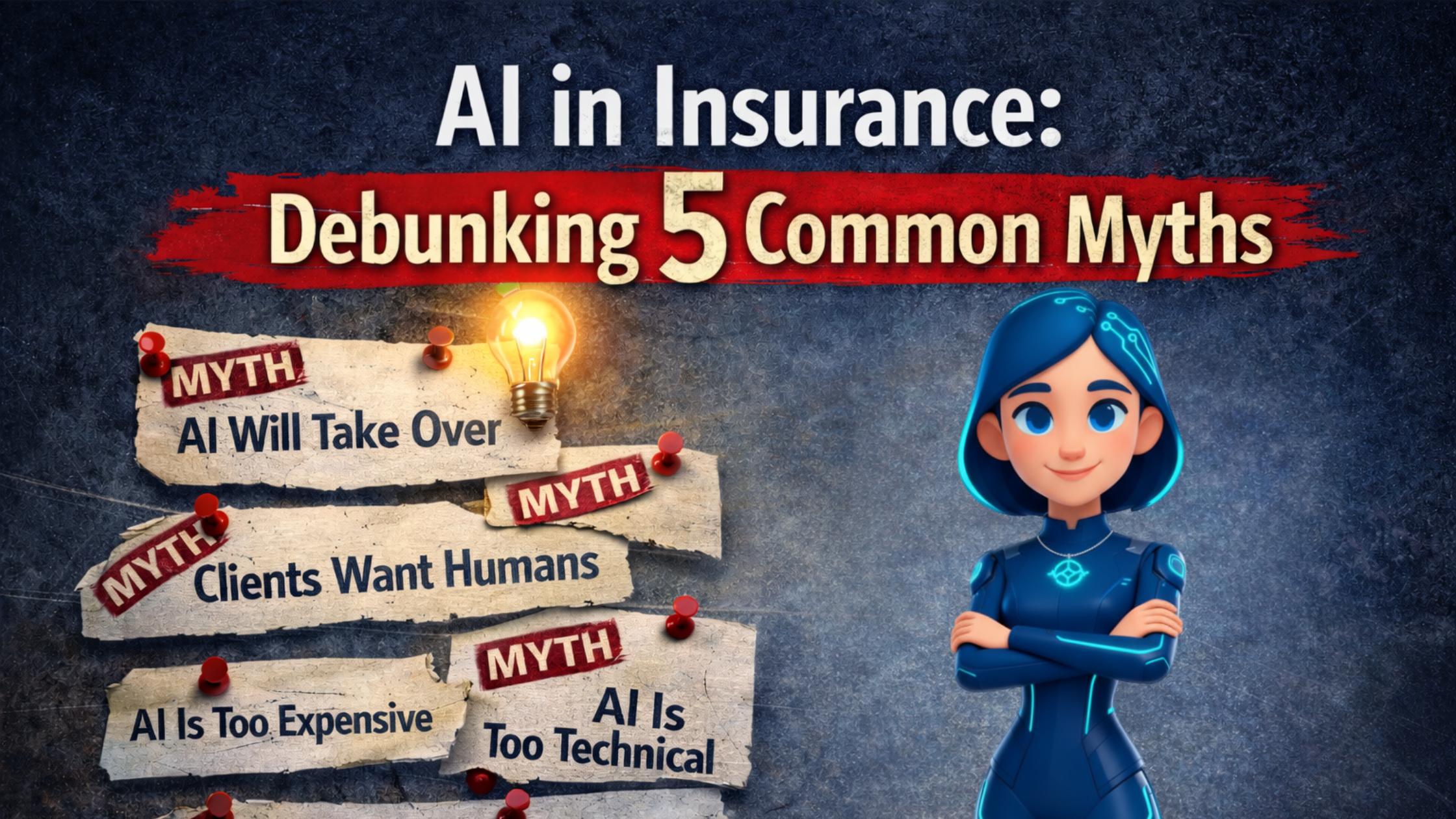
As AI becomes more prevalent in the insurance industry, we hear the same concerns repeatedly. Let’s address the most common myths about AI in insurance and reveal the reality.
Myth #1: “AI Will Replace Agents”
The Reality: AI doesn’t replace agents—it empowers them. Think of AI as your tireless assistant, not your replacement.
What AI Does:
- Handles routine inquiries
- Schedules appointments
- Sends follow-ups
- Qualifies leads
- Manages administrative tasks
What You Do Better:
- Build relationships
- Provide personalized advice
- Handle complex situations
- Close deals
- Offer empathy and understanding
AI handles the repetitive tasks so you can focus on what you do best: being human.
Myth #2: “Clients Won’t Like Talking to AI”
The Reality: Clients care about getting quick, accurate responses—not whether they’re talking to a human or AI initially.
The Data:
- 73% of customers prefer instant responses over waiting to talk to a human
- 67% have used chatbots for customer support
- 90% of customers expect immediate responses
What matters is the quality of service. A well-designed AI provides instant, accurate information 24/7. For complex needs, it seamlessly hands off to you.
Myth #3: “AI Can’t Understand Context or Emotions”
The Reality: Modern AI excels at understanding context, tone, and even emotional cues in text and voice.
Today’s AI Can:
- Detect frustration and escalate to a human
- Remember conversation history
- Adapt tone based on the situation
- Recognize urgency in requests
- Provide empathetic responses
The key is working with AI specifically trained for insurance, like Revna, rather than generic chatbots.
Myth #4: “Setting Up AI is Too Complicated”
The Reality: Modern AI solutions are designed for easy implementation, not IT expertise.
With Revna:
- Day 1: Initial setup and training on your products
- Day 2-3: Testing and refinement
- Day 4: Go live with full support
- Ongoing: Continuous learning and optimization
No coding required. No technical team needed. Just straightforward setup and support.
Myth #5: “AI is Too Expensive for Small Agencies”
The Reality: AI is more affordable than hiring additional staff and provides better ROI.
Cost Comparison:
Traditional Approach:
- Full-time employee: $40,000-$60,000/year
- Part-time employee: $20,000-$30,000/year
- Benefits, training, management time
- Limited to 40 hours/week
AI Assistant:
- Fraction of employee cost
- No benefits or overtime
- Works 24/7/365
- Never calls in sick
- Scales instantly with your business
The ROI:
Most agencies see ROI within the first month through:
- More captured leads
- Higher conversion rates
- Reduced no-shows
- Increased productivity
The Real Value of AI
AI isn’t about replacing the human touch—it’s about giving you more time to be human where it matters most.
Before AI:
- 60% of time on admin tasks
- 40% of time with clients
- Stressed and overworked
- Missing opportunities
With AI:
- 20% of time on admin tasks
- 80% of time with clients
- Focused and energized
- Capturing every opportunity
Making the Right Choice
The question isn’t whether to use AI—it’s which AI partner to choose. Look for:
✅ Insurance-specific training ✅ Easy setup and support ✅ Seamless human handoff ✅ Continuous learning ✅ Proven results
Revna checks all these boxes and more.
See It In Action
The best way to understand how AI can help your agency is to experience it yourself.
Book a Demo to see how Revna handles real scenarios, answers questions, and seamlessly works alongside you to grow your business.
The Bottom Line
AI in insurance isn’t about replacing agents—it’s about empowering them. It’s not about removing the personal touch—it’s about having more time to provide it where it matters most.
Don’t let myths hold you back from the competitive advantage AI provides. The agencies embracing AI today will be the market leaders tomorrow.
Ready to bust these myths in your own agency? Learn more about Revna’s solutions or calculate your potential ROI.